
Is Your Ping Pong Paddle Secretly Judging You?
The Science Behind Why Some Players Win and Others Just Make Excuses
Imagine a ball smaller than a lemon, traveling faster than a city cyclist, spinning like a tornado in miniature. Welcome to the hidden physics circus of table tennis, where 300 million players worldwide swing paddles in garages and Olympic arenas alike. This deceptively simple game – born as Victorian parlor entertainment – conceals ballistic secrets that make rocket science look straightforward. The ball's hollow celluloid body weighs just 2.7 grams yet withstands impacts equivalent to a car accelerating 0-60 mph in 0.003 seconds. Professional players track its trajectory through neural pathways faster than conscious thought, their brains processing spin calculations Einstein would admire.
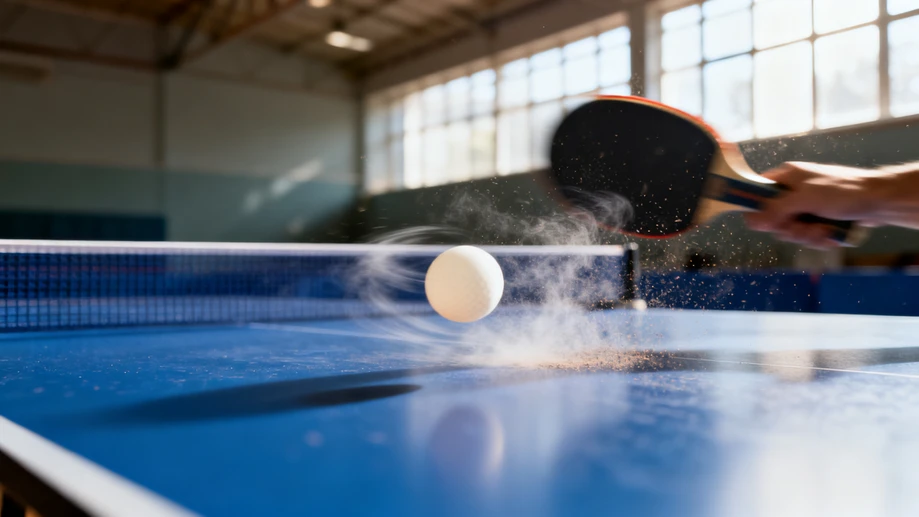
Spin is the dark wizardry separating champions from basement hobbyists. A topspin shot rotates forward 50 times per second, creating an invisible air vortex that sucks the ball downward onto the table. Backspin reverses this magic, making the ball float like a disobedient soap bubble. The most diabolical serves combine sidespin with unpredictable bounces – a "ghost serve" can swerve mid-air like a curveball then skid sideways upon landing. Scientists at the German Sport University Cologne found elite players detect spin direction within 0.2 seconds of ball contact, their cerebellum predicting trajectories before the conscious mind registers the shot. This explains why amateurs often swing wildly at empty air while pros appear psychic.
Your paddle's rubber surface holds more secrets than a spy novel. Modern "inverted" rubbers feature microscopic pimples facing inward, creating suction that grips the ball like Velcro. "Pips-out" rubbers have outward-facing nubs that reduce spin sensitivity – perfect for defensive players who turn opponents' power against them. Olympic athletes customize their paddles with rubber sponges softer than memory foam, tuned to specific frequencies that amplify spin. During the 2021 World Championships, sensors revealed players imparted 9000 rpm spin – enough rotation to make a helicopter blade jealous. Yet the greatest equipment hack remains shockingly low-tech: world number one Fan Zhendong reportedly stores his paddle in a ziplock bag with orange peels to maintain perfect stickiness.
Human physiology transforms at the table. During intense rallies, players' heart rates hit Tour de France levels while executing footwork requiring ballet precision. Studies show their eyes dart between the ball's contact point on the opponent's paddle and predicted landing spot – a visual triangulation impossible without 20/8 superhuman vision. Reaction times drop below 100 milliseconds, faster than the blink reflex. Neuroscientists attribute these feats to "chunking," where the brain compresses complex spin calculations into automatic responses. This explains why amateurs freeze under pressure while champions execute returns before consciously seeing the shot – their motor cortex bypassing slower cognitive pathways.
The true beauty lies in table tennis' democratic genius. Unlike sports demanding towering height or brute strength, this microcosm of physics rewards anyone with $20 equipment and willingness to learn its secrets. From Tokyo medalists to 80-year-old community center warriors, players share the same epiphany: that tiny plastic sphere obeys immutable laws of aerodynamics, not luck. So next time your serve flies off the table, remember – it's not your paddle judging you. It's Newton's ghost laughing from the rafters with a stopwatch and a wicked grin.