
Did You Know Your Local Park Holds Secrets of Olympic Proportions?
Unraveling the hidden geometry and science behind everyday sports surfaces
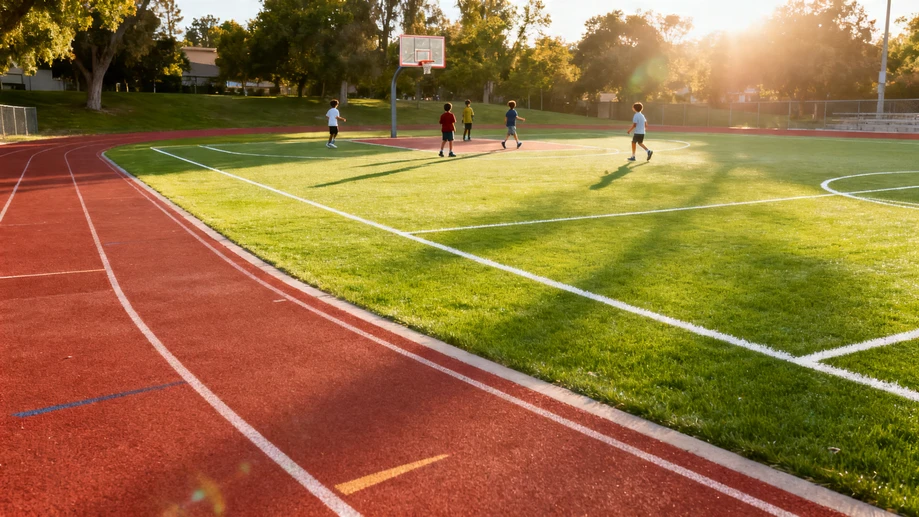
That patch of grass where kids chase soccer balls? It's a marvel of physics disguised as playground real estate. Modern turf isn't just dirt and grass – it's a layered sandwich of drainage systems, root zones, and precisely engineered soil blends. Beneath your sneakers lies a complex ecosystem where soil composition determines ball bounce, and grass density affects athlete injuries. Scientists have discovered that the ideal pitch has 15-20% clay to prevent hardening, mixed with sand for drainage and organic matter for root health. Even the humble neighborhood court holds more secrets than a spy novel!
Ever notice how basketball courts feel springier than parking lots? Thank the magical cushioning layers beneath the hardwood. Professional courts feature rubberized pads or foam systems that absorb up to 40% of impact forces – literally saving knees from destruction. The famous parquet floor of Boston Garden wasn't just pretty; its interlocking oak pieces distributed weight like a puzzle. Meanwhile, the vibrant blue of indoor hockey rinks isn't for aesthetics alone – it creates high contrast against the puck, while specialized plastic tiles reduce friction to mimic ice. Every color and material choice is a silent conversation between science and sport.
Track surfaces have undergone a revolution since cinder gave way to synthetic wonders. Modern tracks are temperature-sensitive cocktails of rubber granules and polyurethane that can make runners 2% faster – the difference between gold and silver. The iconic Mondotrack WS used in Olympics contains recycled sneakers and repels rainwater like a duck's back. But here's the kicker: the exact formula varies by climate. Tracks in rainy Seattle have different porosity than those in desert Dubai, all calibrated to maintain consistent bounce whether it's drizzling or blazing. That rubbery smell? That's the scent of victory chemistry.
Even the sand in beach volleyball courts isn't left to chance. Olympic standards require grains between 0.3-2mm diameter – too coarse causes abrasions, too fine creates dust clouds. The perfect court has 40cm depth for safe diving, with salt content monitored to prevent clumping. Meanwhile, skatepark concrete is mixed with fly ash for extra smoothness, while BMX dirt jumps demand specific clay-to-sand ratios to hold shapes during mid-air tricks. These surfaces are so precisely engineered that Wimbledon's grass is cut to exactly 8mm, while baseball infields use calcined clay that absorbs water like a sponge during rain delays.
The next time you tie your sneakers, remember you're stepping onto a stage where geology meets geometry. From the Fibonacci spiral of a baseball's stitching to the 22-degree bank of a velodrome curve, every angle and texture is a love letter to human ingenuity. These unassuming rectangles of grass, pavement, and sand represent centuries of trial, error, and eureka moments – proving that sometimes, the most extraordinary science happens right under our feet.