
Is Your Brain Faster Than a Ping Pong Ball?
Unraveling the lightning-fast science behind the world's most reflex-intensive sport
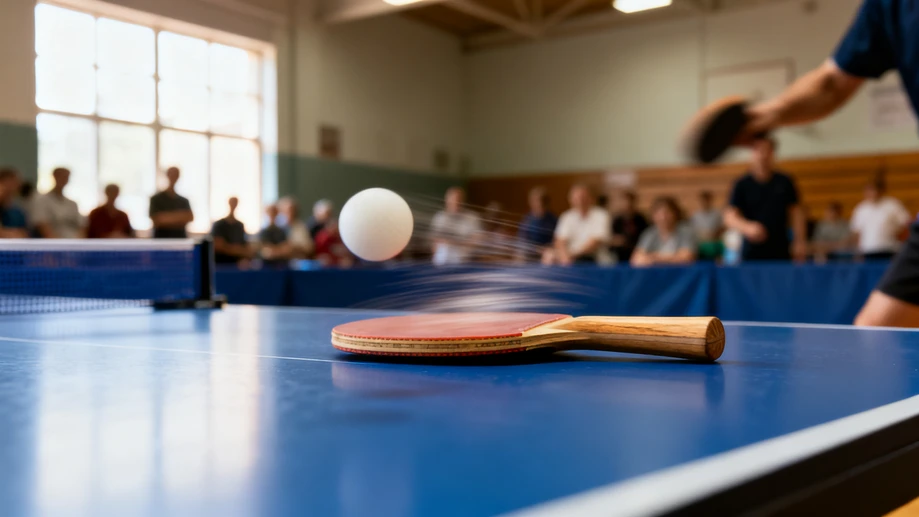
Imagine a tiny sphere rocketing toward your face at 70 miles per hour – faster than a city speed limit. That's the reality of professional ping pong, where players have less time to react than a blink lasts. The ball spends mere milliseconds crossing the table, forcing brains to process spin, trajectory, and opponent positioning in a neural flash. Studies show elite players make decisions in under 100 milliseconds, tapping cognitive abilities comparable to fighter pilots. This isn't just recreation; it's a high-speed chess match where neurons fire like popcorn in a microwave.
The magic lies in spin – that invisible force turning a plastic ball into a physics-defying projectile. Topspin makes the ball dive like a falcon, while backspin creates a floating effect that defies gravity. Players brush the ball at microscopic angles, creating rotations exceeding 150 revolutions per second. When this spinning comet hits the opponent's paddle, friction transforms it: a topspin shot rockets upward upon contact, while backspin dies abruptly. Professionals read these spins by tracking the opponent's paddle angle and wrist flick – a skill requiring years to master. Some serves even combine side-spin with backspin, making the ball curve sideways before dropping like a stone.
Your brain undergoes Olympic-level training during every rally. Neuroscientists discovered ping pong uniquely activates both hemispheres simultaneously, improving hand-eye coordination by 30% more than tennis. The prefrontal cortex works overtime predicting ball trajectories, while the cerebellum fine-tunes motor responses. MRI scans reveal ping pong players develop thicker neural pathways in visual processing areas – essentially upgrading their biological hardware. Regular play even delays cognitive decline; seniors playing twice weekly show memory improvements equivalent to being five years younger. The sport literally reshapes brains, creating ping pong-specific neural superhighways.
Beyond mental gymnastics, ping pong offers bizarre physical advantages. Players burn 272 calories per hour – equivalent to brisk walking – through constant micro-movements invisible to spectators. The rapid shifts between forehand and backhand stances build core strength comparable to pilates, while lunges for distant balls enhance flexibility. During intense matches, heart rates can hit 150 bpm, matching moderate cycling. The real workout is for the eyes: tracking the ball strengthens ocular muscles, reducing digital screen fatigue. Some optometrists even prescribe ping pong for patients with lazy eye syndrome!
This humble game birthed surreal world records. The longest rally lasted 8 hours 40 minutes – requiring 32,000 consecutive shots. In 2016, a robotic arm named Forpheus became the first AI table tennis coach certified to train humans. Meanwhile, the "ghost serve" remains the sport's holy grail: a shot so spin-heavy it appears to curve mid-air before vanishing sideways off the table. Yet even amateurs experience magic – like the "edge ball" that clips the table corner by 0.1mm, producing a musical "ping" that echoes through garages and basements worldwide.
So grab a paddle. Whether you're playing in a community center or on a homemade basement table, you're joining a 300-million-player global tribe. You'll sharpen synapses with every whizzing ball, laugh at unpredictable bounces, and experience the primal thrill of outsmarting physics. As neurosurgeons confirm: no game accelerates human reaction times quite like this deceptively simple dance of plastic, wood, and spin. Your brain may never move faster.