
Did You Know Frisbees Defy Physics Every Time You Toss One?
The secret aerodynamics turning your backyard throw into a science spectacle.
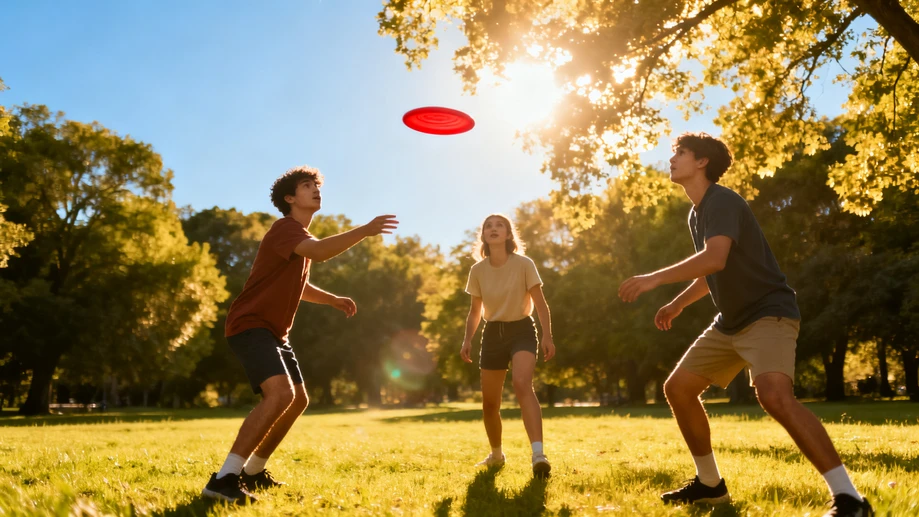
Picture this: you fling a plastic disc across a sun-drenched park, watching it curve through the air like a disobedient UFO. That humble Frisbee isn't just dodging your friend's grasp – it's performing physics-defying maneuvers that baffled NASA engineers for decades. When Yale students first tossed pie tins from the Frisbie Baking Company in the 1920s, they unknowingly kickstarted an aerodynamic revolution. The magic lies in the spin: as the disc rotates, gyroscopic stability locks its orientation while Bernoulli's principle sucks air faster over the curved top, creating lift. This dual-action allows Frisbees to glide 100 meters with barely any effort – a feat that would make paper airplanes weep with envy.
Ever wonder why a Frisbee floats like a leaf but hits like a freight train? Credit the rim's genius design. That curled edge acts as a miniature wing, trapping a vortex of air that reduces drag by 85% compared to flat discs. During Olympic testing in 1968, researchers discovered optimal flight occurs at a 12-degree tilt – any steeper and it stalls like a clumsy pelican. The disc's wobble isn't a flaw either; that precession motion self-corrects mid-flight like a tightrope walker's balancing pole. Even the dimples matter – 28 strategically placed indentations create turbulent airflow that clings to the surface longer than a koala to a eucalyptus tree.
Transform any park into a physics lab with these pro-tips: Grip the rim with your index finger curled underneath like you're holding a wine glass. Snap your wrist like cracking a whip to achieve 600+ RPM – enough spin to stabilize a helicopter blade. Release at hip height with your palm facing the sky, following through toward your target like pointing at a shooting star. For maximum hang time, throw into a headwind; the disc thinks it's moving faster than reality, boosting lift like an invisible elevator. Avoid the "death wobble" by ensuring the spinning axis stays perpendicular to the ground – unless you enjoy watching your disc dive-bomb picnics.
Beyond backyard fun, Frisbee science spawned serious sports. Ultimate Frisbee players exploit gyroscopic torque to throw mind-bending "hammer" shots that drop vertically into end zones. Disc golf champions use overstable discs that bank left harder than a London taxi, while freestylers manipulate air currents to keep discs aloft for minutes using only fingertip brushes. The current flight record? 338.2 meters by David Wiggins Jr. – equivalent to tossing from the Statue of Liberty's torch to Ellis Island. Even dogs demonstrate instinctive understanding of disc aerodynamics, intercepting flight paths with calculated pounces that would impress MIT engineers.
Your brain gets a workout too. Tracking a Frisbee's parabolic arc activates three-dimensional spatial processing rarely used in daily life. Neuroscientists at UC San Diego found regular players develop 23% better peripheral vision and decision-making speed than non-throwers – benefits similar to elite tennis players. The split-second calculations required to catch a curving disc stimulate the cerebellum's motion-prediction circuits, literally rewiring neural pathways. No wonder colleges from Harvard to Tokyo offer Frisbee physics courses; it's the only sport where failing a test means getting smacked in the face by Bernoulli's equations.
Next time you unleash a soaring backhand, remember you're conducting a symphony of fluid dynamics. That spinning plastic is bending air molecules to its will, creating lift where none should exist, and defying gravity through sheer angular stubbornness. So grab a disc, head outside, and become part of a 100-year experiment in airborne wizardry – where every throw proves that sometimes, the most profound science comes wrapped as play.